⚠️ Historical Documentation Notice
This document is part of a historical archive and is presented for scholarly research and educational purposes.
The content reflects historical perspectives and should be understood within its historical context.
David Irving responds
1) Do you think you were unjustly treated in your trials?
Answer: The Lipstadt trial,
2000: Read my short diary of the trial with comments that may assist; it is a pdf file.I have also written an extensive chapter or chapters on the Lipstadt Trial for my memoirs.
Still in handwriting. In these, I state that the
Judge, Sir Charles Gray, was in my view wrong on several important matters:
 (a)
(a)
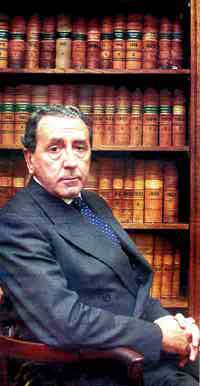
Sir Charles Gray (right) allowed the Defence
lawyers to submit an amended defence only a few
days before the trial began, in which the entire
axis of the defence was changed; it involved
dumping on me a score of ring binders with
expert statements and documents and exhibits in
the days around Christmas 1999, with the trial
beginningon January 13, 2000. Being a litigant
in person, with no vast legal team behind me, I
could not possibly master these new papers in
time. It is my own fault that I did not protest
at the trial management hearing on this issue,
but I could not at that time anticipate the
deluge of files, tens of thousands of pages of
documents, which began after he ruled the new
defence permissible.Mr Justice Gray should have
ruled that either (i) the defence has had three
and a half years to prepare the trial, and a
last minute change of defence is not permitted;
or that (ii) the plaintiff should apply for the
trial date to be adjourned (which the Court
could not easily have done, as the Judge had by
then read all the files, and courtroom space had
been booked and the expert witnesses were
already flying in).- (b) Gray J later called the “fees” paid to
the six expert witnesses,some of them getting
over a quarter of a million dollars, “obscene”.
I agree. How can any witness remain neutral in
the face of such inducements? (See this
website for the interim payments made to the
witnesses.) - (c) Gray J allowed the Dutch/Canadian expert
witness Professor
Robert Jan Van Pelt to give testimony on
the architecture of Auschwitz and other sites,
although in my opening cross examinationI
elicited the confession that Pelt had never
studied architecture and was not even
allowed to call himself an architect in
consequence; Gray J further allowed Pelt to give
expert testimony on matters far beyond his ken
including pest control, toxicology, document
authentication, and the German language;
moreover, Pelt and all the other expert
witnesses were no longer neutral, as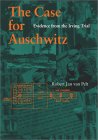 the
the
rules require,because they had all signed book
deals (which Pelt
denied under my cross examination, on oath:
i.e., he perjured himself); Professor Richard
J “Skunky” Evans (right) perjured
himself too, denying explicitly that he bore any
ill feeling toward me (now read his book on this
same topic!)Evans was clearly not an expert on
the Third Reich either, his knowledge of
colloquial and modern German, and of the top
Nazi personalities, was very patchy. - (d) I argued in my opening
submissions to Gray J that the court should
concern itself not with what happened or did not
happen sixty years ago, but with what happened
within the four walls of my study when I was
writing my books: did I have documents before me
which I willfully ignored or deliberately
misconstrued when writing myvarious books? It
is not an abstruse point at all, and Gray J
nodded sagely, but he still allowed the trial to
develop into an examination of the history of
the Holocaust — with the absurd result that I
found myself, although I had never proclaimed
myself to be an Holocaust historian, being
cross-examined on documents that the defence had
brought into court that morning and I had never
seen before: why?And why did the Court tolerate
it? - (e) Most damaging of all: although in her
book Lipstadt had never imputed either
anti-semitism or racism to me, and the two
issues had consequently not been pleaded, large
parts of the defence turned on these
allegations: grossly prejudicial and totally
irrelevant; her
lawyers had managed to get all my pre-emptive
Discovery documents proving the opposite struck
out in the monthsbefore they submitted their
! Gray J himself
amended Defence too
interrupted Rampton’s
closing statement with the hypothetical
question, Can an anti-Semite not write true
history?, only to ignore it in his Judgment.
Gray J should have excluded all such prejudicial
and deeply irrelevant arguments at a very early
date in the trial. It is my fault that I did not
ask the Court to do so, through inexperience.I
was a litigant in person, and the Court should
itself have ruled such issues inadmissible,
because highly prejudicial and not originally
pleaded. Both the Court and the Defence were
pandering however to an increasingly hostile
press (hostile to me, that is, because editors
and advertising managers know on which side
their bread is buttered).2) You have experienced court in a country where they have laws banning Holocaust denial. What is your opinion of these laws? Are they an affront to freedom of speech?
Answer: I recommend that you read
my short book on my 2005 arrest, trial and imprisonment — it is posted in English on my website.European law is, broadly speaking, very different from the Anglo-Saxon laws with which we and the Americans and the British Empire countries are familiar. We are innocent until proven guilty; in Europe, the
reverse is true.It reached its absurd peak when I found myself ambushed by armed Austrian police on
November 11, 2005 and indicted because of opinions I had expressed sixteen years earlier to a small audience in a Vienna restaurant, perhaps forty souls. (Twelve or less would have ruled the case out anyway, even under their laws).The police had attended all my Austria talks, and reported in internal documents that I had committed no offences; when the largely Jewish outcry began in the press on November 6, 2005,
Vienna’s police president then felt he had to issue his warrant, secure perhaps in the knowledge that I was no longer on Austrian soil.I revisited the country three times after that, with the full knowledge of the authorities, and nothing happened. The 2005
ambush and imprisonment cost me around half a million pounds in lost contracts, a year’s lost income, a lost home and possessions, a cancelled legacy(*), air tickets, speaking engagements and stolen cars (from London airport); it very nearly destroyed my family too. But I shall not allow this sad episode in Austrian history to rule the way I write.Good luck with the dissertation
* Explanatory note, in response to inquiries: “A very nice couple in [Germany] whom I shall not name (who knows who else reads these emails), were a doctor and his wife, total strangers to me, and elderly.
Out of the blue four years ago she wrote me enclosing the copy of a will they had made out … in my favour leaving me first their home in Munich, as they so admired me, then adding their homes in Bucharest and
Klagenfurt too, as they wanted us to have something to fall back on if I ever grow old. I corresponded regularly with them in the interval.When I was in the Vienna prison I received a letter from the wife, two lines, equally out of the blue: ‘We have cancelled everything, do not ask why, do not write to us again.’ My letters since have been returned unopened.” — I presume that the malicious media mudbath had shocked them.
See Also
- The Nuremberg trials (Document)
- War Crimes Trials (Article)
- Nuremberg Trial — Nov 1996 (Article)
- In the High Court of Justice No. (Document)
- the Nuremberg trials (Article)