The Secret Recording of Hitler Speaking in His Normal Voice
June 4, 1942 — Immola station, near Imatra, Finland
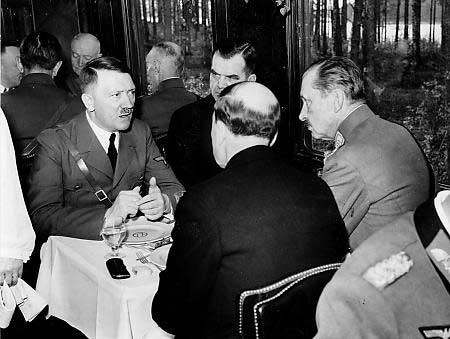
(right).
Historical Context
In the world’s only recording in which Adolf Hitler speaks privately, taken in 1942, he has a “conversation” with the Finnish military commander, Marshal Carl Gustav Mannerheim, on progress on the war front — its victories, and its setbacks.
Hitler’s voice modulation and use of the language on the tape is quite different from the intensity of his public speeches of agitation — in which he seems to be in a trance — which were rehearsed to the last detail right down to the intonation of the sentences.
The recording by the Finnish Broadcasting Company (Yleisradio) was made secretly on June 4, 1942, at Marshal Mannerheim’s 75th birthday party. To everyone’s surprise Hitler showed up himself to congratulate Mannerheim in the special train at Immola station near Imatra where the celebration was held.
After the official speeches, the two leaders continued their conversation in the adjacent salon wagon. For security reasons the train where the celebrations were held was moved to the forested area of Immola, a small station that was easy to guard, which was nevertheless as close as possible to the command headquarters in Mikkeli. Hitler’s visit to Finland was short, lasting only about six hours.
How the Recording Was Made
The unique recording of Hitler speaking off-guard was made by Yleisradio (Finnish National Radio) engineer Thor Damen, who had been ordered to record the official birthday speeches and Mannerheim’s responses.
“Hitler never allowed himself to be photographed or recorded in private situations,” says Lasse Vihonen, head of the Yleisradio archives. “This recording was made in secret. When Hitler and Mannerheim went into the salon wagon for coffee, Damen placed his microphone on the hat rack. The cords came through the window, and the tape recorders themselves were in the next carriage.”
The recording contains about five minutes of Hitler’s official speech and Mannerheim’s response. After that, 11 minutes of their private conversation came on tape. The recording was suddenly cut off — Hitler’s security men spotted the cords coming out of the window. They raised a fuss, threatening Damen with a gesture suggesting cutting of the throat.
According to Vihonen, the security men demanded that the tape be immediately destroyed, but Yleisradio was allowed to keep the reel, after promising to keep it in a sealed container. One of the tapes ended up in the hands of the head of the state censors’ office, Kustaa Vilkuna, and he later gave it to Yleisradio in 1957. The second tape was kept by Damen himself, who died in 1965.
It was found in 1992 by his son Henrik Damen, hidden away in his father’s garage.
Listen to the Recording
The audio below contains the full recording — the German text only, without Finnish commentary. Duration: approximately 11 minutes.
🎧 Audio: Hitler-Mannerheim Conversation, June 4, 1942
Original recording from Yleisradio (Finnish National Radio) archives. MP3 format, also available as original WMA file.
Transcript (English Translation)
The transcript below, with italics used to emphasize the heightening of voices in the original recording, was prepared by journalist Jürgen Schielke. Repeated words and hesitations have been removed for readability.
Hitler: …a very serious danger, perhaps the most serious one — its whole extent we can only now judge. We did not ourselves understand — just how strong this state [the USSR] was armed.
Mannerheim: No, we hadn’t thought of this.
Hitler: No, I too, no.
Mannerheim: During the Winter War — during the Winter War we had not even thought of this. Of course…
Hitler: (Interrupting) Yes.
Mannerheim: But so, how they — in reality — and now there is no doubt all they had — what they had in their stocks!
Hitler: Absolutely. This is — they had the most immense armaments that people could imagine. Well — if somebody had told me that a country — (Hitler is interrupted by the sound of a door opening and closing.) If somebody had told me a nation could start with 35,000 tanks, then I’d have said: “You are crazy!”
Mannerheim: Thirty-five?
Hitler: Thirty-five thousand tanks.
Another Voice In Background: Thirty-five thousand! Yes!
Hitler: We have destroyed — right now — more than 34,000 tanks. If someone had told me this, I’d have said: “You!” If you are one of my generals had stated that any nation has 35,000 tanks I’d have said: “You, my good sir, you see everything twice or ten times. You are crazy; you see ghosts.” This I would have deemed possible. I told you earlier we found factories, one of them at Kramatorskaja, for example. Two years ago there were just a couple hundred [tanks].
We didn’t know anything. Today, there is a tank plant, where — during the first shift a little more than 30,000, and round the clock a little more than 60,000, workers would have laboured — a single tank plant! A gigantic factory! Masses of workers who certainly lived like animals and…
Another Voice In Background: (Interrupting) In the Donets area?
Hitler: In the Donets area. (Background noises from the rattling of cups and plates.)
Mannerheim: Well, if you keep in mind they had almost 20 years, almost 25 years of freedom to arm themselves…
Hitler: (Interrupting quietly) It was unbelievable.
Mannerheim: And everything — everything spent on armament.
Hitler: Only on armament.
Mannerheim: Only on armament!
Hitler: (Sighs) Only — well, it is — as I told your president [Ryti] before — I had no idea of it. If I had an idea — then it would have been even more difficult for me, but I would have taken the decision [to invade] anyhow, because — there was no other possibility. It was certain, already in the winter of ’39/’40, that the war had to begin. I had only this nightmare — but there is even more!
Because a war on two fronts would have been impossible — that would have broken us. Today, we see more clearly than we saw at that time — it would have broken us.
Hitler: And my whole — I originally wanted to — already in the fall of ’39 I wanted to conduct the campaign in the west — on the continuously bad weather we experienced hindered us. Our whole armament — you know, was — is a pure good weather armament. It is very capable, very good, but it is unfortunately just a good-weather armament. We have seen this in the war.
Hitler: In the fall of 1939 we always faced the question. I desperately wanted to attack, and I firmly believed we could finish France in six weeks. However, we faced the question of whether we could move at all — it was raining continuously.
And I know the French area myself very well, and I too could not ignore the opinions of many of my generals that we probably would not have had the élan, that our tank arm would not have been effective, that our air force could not have been effective from our airfields because of the rain.
Hitler: If I had in ’39 eliminated France, then world history would have changed. But I had to wait till 1940, and unfortunately it wasn’t possible before May. Only on the 10th of May was the first nice day — and on the 10th of May I immediately attacked. I gave the order to attack on the 10th on the 8th.
Hitler: First the occupation of — then we had the task in Norway — at the same time we faced — I can frankly say it today — a grave misfortune, namely the weakness of Italy. Because of — first, the situation in North Africa, then, second, because of the situation in Albania and Greece — a very big misfortune. We had to help.
Hitler: I had a conversation with Molotov at that time, and it was absolutely certain that Molotov departed with the decision to begin a war, and I dismissed him with the decision to forestall him. There was — this was the only — because the demands that man brought up were clearly aimed to rule Europe in the end. (Practically whispering here.) Then I have him — not publicly… (fades out).
Hitler: Already in the fall of 1940 we continuously faced the question: shall we consider a break up [in relations with the USSR]? At that time, I advised the Finnish government to negotiate and to gain time and to act dilatory in this matter — because I always feared that Russia suddenly would attack Romania in the late fall and occupy the petroleum wells, and we would have not been ready in the late fall of 1940.
If Russia indeed had taken Romanian petroleum wells, then Germany would have been lost.
Hitler: We had huge German production: however, the demands of the air force, our Panzer divisions — they are really huge. It is a level of consumption that surpasses the imagination. And without the addition of four to five million tons of Romanian petroleum, we could not have fought the war — and would have had to let it be.
Hitler: There were four topics. The one topic that involved Finland was the freedom to protect themselves from the Finnish threat, he said. [I said] You do not want to tell me Finland threatens you! But he said: “In Finland they take action against the friends of the Soviet Union. They would take action against our society, against us — they would continuously persecute us, and a great power cannot be threatened by a minor country.”
Hitler: I said: “Your existence isn’t threatened by Finland! That is, you don’t mean to tell me that your existence is threatened by Finland?”
Mannerheim: (Interrupting) Laughable!
Hitler: “…that your existence is threatened by Finland?” Well, [he said] there was a moral threat being made against a great power. Then I told him we would not accept a further war in the Baltic area as passive spectators. In reply he asked me how we viewed our position in Romania. And at that time I told him: “I don’t think it is directed at you, because I don’t think you have the intention of attacking Romania.”
Hitler: “Yes,” he told me, but he wanted to know more precisely if this guarantee… (A door opens and the recording ends.)
Significance of the Recording
Journalist Jürgen Schielke, who transcribed the words on the tape, was surprised at the “working class language” used by Hitler and his turns of phrase which reflect the speaker’s educational shortcomings. To top it all off, Hitler pronounces the name of the Finnish capital Helsinki as “Helsinski.”
This recording was used by German actor Bruno Ganz when he rehearsed Hitler’s manner of speaking for the role of the Führer in the film Der Untergang (The Downfall: Hitler and the End of the Third Reich). Ganz studied Hitler’s full-bodied and deep baritone, and his quiet style of speaking with a tendency to go into monologues. The tape offered the actor fantastic material for practice, but Ganz was sorry that it was so short.
The tape has been thoroughly studied in Finland. Two radio documentaries have been produced about the recording, by Eero Saarenheimo and Jorma Kallenautio. In Germany, a study of the tape’s authenticity was made in the acoustics laboratory of the German Central Criminal Police.
Professor Ohto Manninen of the Finnish National Defence College has noted that the most interesting parts are Hitler’s explanation of the disaster that took place on the outskirts of Moscow, and his comment on how his army does well in summertime attacks, but that it is not an army for rain or winter weather.
Source: Helsingin Sanomat, Helsinki, Finland, September 15, 2004. Article by Kirsikka Moring. Originally posted on FPP website September 26, 2004.