⚠️ Historical Documentation Notice
This document is part of a historical archive and is presented for scholarly research and educational purposes.
The content reflects historical perspectives and should be understood within its historical context.
To
begin with, there was no Schindler’s List.
November 24, 2004
Book
Adds Layers of Complexity to the Schindler
Legend
By Diitia Smith
AN authoritative new biography of Oskar Schindler, the
German businessman who saved more than
1,000 Jews from the Nazis, clashes sharply with his idealized portrayal in the
Oscar-winning 1993 Steven Spielberg movie
“Schindler’s List” and the 1982
historical novel by Thomas Keneally that inspired it.
The Schindler who emerges in this latest account — based on interviews with
Holocaust survivors and newly discovered papers, including letters stored in a suitcase by a mistress — is far more flawed than the one depicted in the movie and novel. Even so, scholars say, the fresh revelations about Schindler’s darker side cast his moral transformation and heroism into starker relief.
To begin with, there was no Schindler’s
List.
“Schindler had almost nothing to do with the list,” said David M.
Crowe, a Holocaust historian and professor at Elon University in North
Carolina, whose book, “Oskar Schindler:
The Untold Account of His Life, Wartime
Activities and the True Story Behind the
List,” was published this fall by
Westview Press.
In the film, Schindler, played by
Liam Neeson, is shown in 1944
giving the Jewish manager of his enamelware and arms factory in Krakow,
Poland, the names of Jewish workers to be taken to the relative safety of what is now the Czech Republic. But at the time,
Mr. Crowe said in a telephone interview,
Schindler was in jail for bribing Amon
Göth, the brutal SS commandant played by Ralph Fiennes in the film.
And the manager, Itzhak Stern
(Ben Kingsley), was not even working for Schindler then.
Mr. Crowe said that there were nine lists. The first four were drawn up primarily by Marcel Goldberg, a corrupt Jewish security police officer and assistant to an SS officer in charge of transporting Jews. (Goldberg was later accused of accepting bribes and of favoritism.) Schindler suggested a few names, Mr. Crowe said, but did not know most of the people on the lists. The authors of the other five lists are unknown.
Mr. Crowe said
the legend of “the list” arose partly
from Schindler himself, to embellish
his heroism. He was trying to win
reparations for his wartime losses, and
Yad Vashem, the Jewish Holocaust
memorial organization in Jerusalem, was
considering naming him a “righteous
gentile,” an honor given to someone who
risked death to save Jews.
Those he saved further enhanced the legend because “they adored him,” Mr.
Crowe said, “and they protected him.”
No one doubts that Schindler, an ethnic
German born in what was then
Austria-Hungary, was a moral hero, but the revelations add deeper texture to his story.
It has long been known that Schindler was a spy for German counterintelligence in the late 1930’s, but he played down those activities. Yet Mr. Crowe said that
Czech secret police archives refer to
Schindler as “a spy of big caliber and an especially dangerous type.” Mr. Crowe also said that Schindler compromised
Czechoslovak security before the Nazi invasion and was imprisoned. Later, the
Czechoslovak government tried to prosecute him for war crimes.
Schindler was also the de facto head of a unit that planned the
Nazi invasion of Poland.
Schindler, a big, charming man, was a drinker and womanizer, as depicted in the novel and film. But Mr. Crowe said that he also had two illegitimate children whom he ignored.
There were also rumors, briefly mentioned in the book and film, that after
Schindler moved to Krakow in 1939 as a carpetbagger following the Nazi invasion, he stole Jewish property and ordered Jews beaten. Although the charges were unproven, Mr. Crowe discovered that Yad
Vashem was so concerned that it delayed designating Schindler a righteous gentile.
The film’s epilogue says Schindler was named in 1958, 16 years before his death in 1974. But Mr.
Crowe found that he was officially named in
1993, after Yad Vashem learned that
Schindler’s widow, Emilie, who also behaved heroically, was coming to
Jerusalem to participate in the film. Both received the honor, he posthumously.
There are many books about Schindler, including accounts by survivors and
Emilie’s memoirs, but Mr. Crowe’s is the first comprehensive biography to draw on newly available records. Mr. Crowe is a member of the education committee of the
United States Holocaust Memorial Museum in
Washington, and the author of a history of the Gypsies of Russia and Eastern
Europe.
He dismissed some scenes in the film and book that are part of Schindler’s legend. For instance, in the film
Schindler is shown riding with his mistress on Lasota Hill in Krakow and watching the clearing of the ghetto in
March 1943, when he sees a little girl seeking shelter. The scene depicts
Schindler’s moral awakening, but Mr. Crowe called it “totally fictitious.” He said that it would have been impossible to see that part of the ghetto from the hill, and that Schindler never saw the girl.
Schindler’s transformation was more gradual, Mr. Crowe said, and even before the ghetto was cleared he was appalled by the mistreatment of the Jews.
“Steve is a
very wonderful, tender man,” Mr. Crowe
said of Mr. Spielberg, “but
‘Schindler’s List’ was theater and not
in an historically accurate way. The
film simplifies the story almost to the
point of ridiculousness.” Mr. Crowe
also said that he admired Mr.
Keneally’s novel.
 Mr.
Mr.
Keneally, who interviewed 50 survivors and used available archives for his novel, said it was understandable that Mr.
Spielberg and the screenwriter Steven
Zaillian would take dramatic license with some events. “I believe Steven
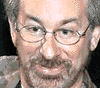
[Spielberg, right] behaved with integrity,” he said. “And he does make Schindler ambiguous.”
Mr. Spielberg is filming a movie and could not be reached for comment, but a spokesman, Marvin Levy, said in an e-mail message that “Schindler was such an enigmatic figure in life, it is not totally surprising that other information or alleged information could continue to surface in death.” Michael
Berenbaum, former president of the
Survivors of the Shoah Visual History
Foundation, established by Mr.
Spielberg to record survivors’ memories, made a distinction between the craft of the historian and the artist.
“It does neither an injustice to the novel, the film or to history to say that the story is more complex,” he said.
Mr. Crowe “is not even altering the story,” Elie Wiesel, the author and
Holocaust survivor, said. “He’s complicated it. He’s made Schindler more human, and also more extraordinary.”
After Schindler moved his factory to
Brünnlitz in the present-day Czech
Republic, a period dealt with only briefly in the film, he stalled the manufacture of weapons, and none were ever made for the
Nazis. He also bribed Nazi officers and distracted them with alcohol to save his workers. Mr. Keneally describes his heroism. In Krakow, Mr. Crowe said, “he could use the black market to supply his workers with food and health care.”
But by the time he arrived in Brünnlitz the
Russians were advancing, making conditions harsher. “He risks his life and takes all the money he made in Krakow and spends every bit trying to feed his Jews and keep them healthy,” Mr. Crowe said.
Emilie
Schindler
In an episode known as the Golleschau
transport, which is depicted in the book
but not the film, two boxcars arrived in
Brünnlitz filled with Jewish
prisoners, some frozen to death. Schindler
and his wife (right)
were able to save many of the
prisoners.
Amid the chaos, Schindler also tried to accommodate Jewish religious law, getting
SS officers drunk so that Jews could be properly buried.
Mr. Crowe said that the only part of the film that angered him was the ending, in which Schindler flees as the Russians advance. The Jews are shown as defeated, but in fact, Mr. Crowe said, Schindler had created “an armed guerilla group of
Jews.”
“They were armed to the teeth, ready to fight till the death,” he said. Hours after Schindler left, they hung a Jew who worked for the Nazis.
In the film, Schindler gives a speech and breaks into tears because he did not do more. But Mr. Crowe obtained a transcript in which Schindler, always a wily pragmatist, also reminded the Jews of how much he had done for them, possibly to protect himself from prosecution for war crimes.
After the war Schindler was a failure.
He squandered money given to him by the
American Jewish Joint Distribution
Committee and moved to Argentina, where he attempted to breed nutria. He then returned to Germany and bought a concrete factory, where workers attacked him for saving Jews during the war. That factory went bankrupt. Schindler continued drinking, and begged Jews he had saved to help him financially. He died from alcoholism and heavy smoking, Mr. Crowe said.
Mordecai Paldiel, director of the Righteous Among the Nations department at Yad Vashem, said the new revelations show that “even people with all these characteristics can do a great, saintly deed.”
“It seems we all have a little angel sitting inside us and just waiting to be allowed to go to the surface, to expose himself,” he said. “A little, saving angel.”
Copyright
2004 The New York Times Company
Our website
dossier on Schilder and the film
Schindler’s List
The
above news item is reproduced without editing other
than typographical
to go on the Mailing List to receive©
Focal Point
2001 write to David
Irving