⚠️ Historical Documentation Notice
This document is part of a historical archive and is presented for scholarly research and educational purposes.
The content reflects historical perspectives and should be understood within its historical context.

Toronto, Canada, Wednesday, September
19, 2007
“Get that Bastard,” man said to her
Prof tells of battle with David
Irving
By LAUREN KRAMER, Pacific
Correspondent
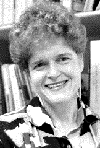
VANCOUVER — When her book Denying the Holocaust: The Growing
Assault on Truth and Memory was published in 1994, Prof.
Deborah
Lipstadt devoted 300 words to David
Irving, whom she called “the most dangerous of Holocaust deniers, an anti-Semite and racist.”
[Website comment: In fact the original book manuscript did not even mention Mr Irving; even as published it contained no hint of any allegation that Mr Irving was an anti-Semite or racist; these inventions were dreamed up by Lipstadt’s British lawyers for her defence strategy.]
“The reason is that he knew the truth but distorted it,” Lipstadt, director of
Emory University’s Institute for Jewish
Studies, told attendees at the Greater
Vancouver Jewish Federation’s Combined
Jewish Appeal opening night event on Sept.
6.
The venue, Schara Tzedeck Synagogue, was filled to capacity with those who came to listen to her talk, “Truth on Trial: My
Day in Court with a Holocaust Denier.”
 But
But
Lipstadt’s time in court with Irving went on much longer than a day — it lasted six years.
It all started after Penguin published her book in the United Kingdom. Shortly thereafter, Lipstadt learned that Irving was planning to sue her for libel.
“This is a man who testified as a witness on [German Holocaust denier] Ernst Zündel‘s behalf, and who called the Holocaust a legend,” she says. “It seemed, at the time, ludicrous that he could sue me for not being a Holocaust denier.”
What she didn’t know back then was that in the United Kingdom, libel laws are precisely opposite to those in the United
States.
Under English libel law, the burden of proof is on the defendant rather than the plaintiff, meaning the onus is on the author of a statement to prove the truth of what he or he she is saying.
[Website comment: Tough! A writer being called upon to prove she’s writing the truth.]
“Irving had waited for the book to appear in the U.K. before suing me — in essence, he had venue-shopped,” she said.
Realizing that she would need to fight,
Lipstadt hired Anthony Julius, senior consultant for the London law firm
Mishcon de Reya and a prominent British lawyer and academic.
Best known for his actions on behalf of the late Diana, Princess of Wales,
[Website comment: His firm charged Diana’s estate a fee of two million pounds, four million dollars, for setting up the charitable fund in her memory] Julius is also known for his opposition to anti-Semitism, and he offered to work on
Lipstadt’s case pro bono.
[Website comment: Later however, as in the Princess
Diana case, he submitted a whopping great bill.
Julius is one of those short-memory folks we all come across in life.]
Twelve questions to put to Prof.
Lipstadt the next time you see her…
Julius promised her that he would fight
the case as vigorously as any commercial
case.
“Also, we wanted to ensure this did not become a ‘did-the-Holocaust-happen’ case, and instead focus on proving I told the truth when I wrote that Irving was a
Holocaust denier and anti-Semite,”
Lipstadt recalled.
“We decided
that if the case went to trial, we
would not call Holocaust survivors to
the stand, because they were witnesses
of fact, and we didn’t think it was
ethical or necessary to subject a
survivor to that.”
Lipstadt, Julius and their team began investigating Irving’s assertions regarding the Holocaust, tracing his footnotes back to the original documents from which he claimed they originated.
“We found distortions over and over again, creating a false impression in reader’s minds, but in a way that sounded credible if you didn’t know the details,”
Lipstadt said.
All through the trial, she wondered what would happen if she lost, or even if she won a “yes, but” victory over Irving.
She also received tremendous support from
Jews around the world.
“People would come up and tell me how much they were counting on me,” she said.
One Holocaust survivor approached her after the first day of the trial. “You are fighting for us. You are our witness,” she said.
Another time, a British man came up to her, explaining that he had helped liberate Bergen Belsen. “Get that bastard,” he told her.
“I felt guarded by this band of people whose life had been shaped by the
Holocaust,” she said. “And ultimately, we won a tremendous victory in which the judge laid waste to Irving’s reputation, finding him to be a Holocaust denier, a falsifier of history, a racist, an anti-Semite and a liar.”
 Lipstadt’s book History on Trial: My Day in Court with David Irving was published in 2005.
[Website comment: It is now, barely two years later, being sold for its scrap value, 82
cents per copy].
[Hot dogs stands]
Illustrations:
Hot dogs are served outside the great tourist attractions, the Auschwitz death camp in Poland (above) and the Holocaust
Museum in Washington DC
- Dossier
on Deborah Lipstadt - Lipstadt
trial index - Trial
transcripts -
Lipstadt’s
praise for Binjamin Wilkomirski, the
(ASSHOL) fraudster and
liar:
“Deborah
Lipstadt has assigned Fragments
in her Emory University class on
Holocaust memoirs.When confronted with
evidence that it is a fraud, she
commented that the new revelations
‘might complicate matters somewhat, but
[the work] is still
powerful.'” -
Twelve
questions to put to Prof.Lipstadt the
next time you see
her… -
Controversy
April 2001 over Emory’s choice of
Deborah Lipstadt as graduation speaker;
won’t get honorary
degree
The
above news item is reproduced without editing other
than typographical
to go on the Mailing List to receive©
Focal Point
2007 write to David
Irving
See Also
- David Irving v Penguin & Lipstadt — Jan 1995 (Article)
- Index: Lipstadt Trial Documents (Article)
- The defeat of the denierDanuta Kean reports on how Penguin p (Article)
- Irving v Lipstadt: Trial Documents (German language) (Article)
- Documents on David Irving's early clashes with Professor Deborah Lipstadt (Article)