⚠️ Historical Documentation Notice
This document is part of a historical archive and is presented for scholarly research and educational purposes.
The content reflects historical perspectives and should be understood within its historical context.
There
is a large intimidation
machine out there which is
waiting to intimidate anyone
that it doesn’t approve
of.
— Professor Mona
Baker.
London,
.
Editorial
opinion
Fury as academics are sacked for being Israeli
By Charlotte Edwardes
A British academic has sparked worldwide protests after sacking two scholars from her highly respected international journals because they are
Israeli.
Mona Baker, a professor at the
University of Manchester Institute of
Science and Technology (UMIST), admitted yesterday that she had dismissed Dr
Miriam Shlesinger and Prof Gideon
Toury because of their nationality.
Despite a storm of complaints raised by her action,
Prof Baker stood by her decision, telling
The Telegraph: “I deplore the
Israeli state. Miriam knew that was how I felt and that they would have to go because of the current situation.”
Prof Baker asked Dr Shlesinger and Prof
Toury to resign from the boards of two academic journals she owns, after signing a website petition last month calling for academics to boycott Israel. When they refused to resign she sacked them.
The dismissals
raised no public opposition from within
British universities. International
academics, however, led by Prof
Stephen Greenblatt, a
world-renowned
Shakespeare scholar at Harvard
University, have now condemned the
decision and called on British
academics to
stand
up for intellectual freedom.
Prof Greenblatt, who flew to England last night to collect an honorary degree from London University, said that Prof
Baker’s actions were “repellent”,
“dangerous” and “intellectually and morally bankrupt”.
A few useful links to look at and pass on: pictures illustrating
Israeli military activities, as extolled by The Daily Telegraph, in the Middle East
- Israeli
Defence Force (Wehrmacht)
shoots a child - Israeli
settlers
(10
pictures) - Droll
female soldier - School
children and soldier href=”http://stcloudinvestor.netfirms.com/Skunk/israelisoldierholdsaboy.jpg”>Soldier
dragging little kid- Israeli
heroes with their trophy
kills
(5
pictures)


He described any policy of singling out a
group for collective punishment as
“grotesque”.
He added: “Excluding scholars
because of the passports that they carry
or because of their skin colour, religion
or political party, corrupts the integrity
of intellectual work.”
Both of the sacked scholars had worked for the periodicals for three years. Dr
Shlesinger, who enjoyed a friendship with
Prof Baker and was even a guest at her house in Manchester, worked for the editorial board of The Translator.
Prof Toury, who teaches at Tel Aviv
University, held an honorary advisory role at Translation Studies Abstracts.
Dr Shlesinger, a respected
American-born academic at the Bar-Ilan
University near Tel Aviv, is also a former chairman of Amnesty International in
Israel and has criticised her country’s policies in the West Bank and the Gaza
Strip.
Prof Baker, who is the director of the centre for translation and intercultural studies at UMIST, was unrepentant, however. Although the boards of the journals remained split over the dismissals, Prof Baker said: “I am not against Israeli nationals per se; it is
Israeli institutions as part of the
Israeli state which I absolutely deplore.
She said that her actions were “my interpretation of what a boycott of Israel means”. Prof Baker added:
“Many people in Europe have
signed a boycott against Israel. Israel
has gone beyond just war crimes.It is horrific what is going on there. Many of us would like to talk about it as some kind of Holocaust which the world will eventually wake up to, much too late, of course, as they did with the last one.”
She conceded, however, that the pair would not have been sacked had they lived in Britain and severed their ties with Israeli institutions.
The petition that Prof Baker signed claims that Israel should be boycotted because it is “racist.” Prof Baker, who refused to disclose where she was born, claimed that her actions were supported by a growing number of academics across Britain and in
Germany. She alleged that since the sackings she had been the victim of a hate campaign.
“My husband and I receive hate
mail every day, up to 50
[letters] a day, some of it
extremely obscene,” she said. “I can’t
read it out it is so obscene and very
threatening. It is also sent to my
university, to my vice-chancellor and
to some of my colleagues, and they
threaten people who want to stay on the
board. The Americans are the worst
offenders.“There is a large intimidation machine out there which is waiting to intimidate anyone that it doesn’t approve of.”
In an open letter to Prof Baker, however, Prof Greenblatt, the president of the Modern Language Association of
America, described the “chilling shadow” cast by her actions. “An attack on cultural co-operation, with a particular group singled out for collective punishment violates the essential spirit of scholarly freedom and the pursuit of truth,” he wrote.
“The pursuit of knowledge does not suddenly come to a halt at national borders. This does not mean that serious scholars must be indifferent to the world’s murderous struggles, but it does mean that they are committed to an ongoing, frank conversation . . .
[that] often includes passionate disagreement.”
The letter is understood to have the backing of other senior academics at
Harvard. Following calls from The
Telegraph, a number of leading academics in Britain lent their voice to
Prof Greenblatt’s condemnation.
Francis Robinson, a professor of history at London University, said:
“Whatever anyone feels about Israel, this is absolutely appalling. Certainly there are strong feelings, not often spoken but nevertheless strongly felt, shared by the majority of British liberal intellectuals about the problems with Israel.
Nonetheless, this sounds dreadful. It runs counter to the very principles of academic freedom.”
Prof Greenblatt’s intervention was welcomed by Lord
Janner, the chairman of the
Holocaust
Educational Trust. He said that the sackings set a worrying precedent: “This is disgraceful and dangerous. You should no more sack an Israeli academic for his nationality than you should a Palestinian in the same situation.
“I do not buy this argument that, just because there are more fee-paying Arab students at UMIST and elsewhere, their views should prevail. In every university in the UK today there are problems between the two groups. They must try to insulate themselves from what is happening in the
Middle East or else you are going to get the most terrible conflicts seeping into our university campuses.”
Prof John Garside, the vice-chancellor of UMIST, distanced himself from the debate. Even though Prof
Baker uses UMIST’s logo in her promotional material for the journals, he said: “The position of UMIST is that the two journals
Prof Baker is involved with have nothing to do with UMIST.
“These are activities that she is involved with in her own time. What happens on those journals and the editorial policy on those journals are entirely a matter for those journals. It’s an issue that we are dealing with internally and not something I want to make any public statement about at this stage.”
A spokesman for the Israeli embassy said: “We think the Palestinian cause is not helped in any way by people trying to shut down those who communicate across boundaries through dialogue and the exchange of ideas. It’s the rejection of the legitimacy of the state of Israel itself which lies at the core of the
Israeli-Arab conflict.”
Additional reporting by Tony
Freinberg and James Pope
Related href=”https://fpp.co.uk/01/05/PA040501c.html”>Boycott All our yesterdays. . . Daily
items on this website: Editorial
opinion
Chronicle
of Higher Education: British Journals
Oust 2 Israeli Scholars From Their
Boards
Lord
Janner gloats on hearing that Mr
Irving’s home and property were seized US
warns Texas businessman against
boycott of Israel
Jewish
academics threaten to boycott
Oxford over Irving speech
threat threat to Oxford Union over
Irving
Daily
Express headline, March 24, 1933:
“Judea Declares War on Germany” (begin
of the Jewish boycott which
triggered German retaliation)
Miami
Jews call for boycott of
Poland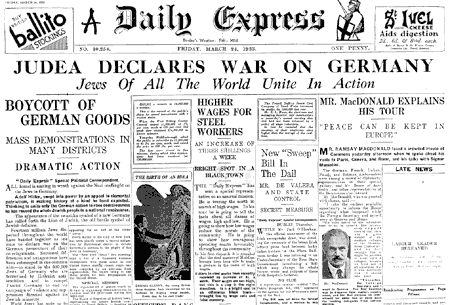
Express headline, 24 Mar 1933