⚠️ Historical Documentation Notice
This document is part of a historical archive and is presented for scholarly research and educational purposes.
The content reflects historical perspectives and should be understood within its historical context.
I
had known [Judge]
Charles Gray for about three
years. We met when, as a
distinguished libel silk, he
appeared on a legal discussion
programme I produce for Radio
4. He had been
outstanding.
http://www.thisislondon.co.uk/dynamic/news/top_story.html?in_review_id=472500&in_rReview_text_id=426467
London, Wednesday, November 7,
2001
Below:
David Irving arrives at the Court of Appeal, ignoring Professor
Lipstadt’s banner-waving supporters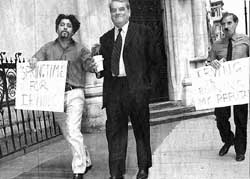 At home with David Irving
by Bruce
Hyman
AN hour into my meeting with the disgraced historian David
Irving, I was afraid that my life might be in danger. The interviewer
Michael Cockerell and I were sitting in the writer’s Mayfair flat when the doorbell rang.
Irving went to answer and returned with a package. We had been talking to him about his libel defeat last year, in which he’d been branded as an “active Holocaust denier”, “anti-Semitic” and “racist” by the judge, Mr Justice Gray.
Unsurprisingly, therefore, David Irving is a man with enemies, and he also regularly receives death threats.
It followed that these might well be my last moments on earth and that my family might have to explain to friends why I was found in the ruins of the home of a notorious Nazi sympathiser.
I tried without success to communicate to Michael my growing sense of panic.
Quite oblivious, Irving was busy ripping open the package. As I looked on helplessly, he pulled out a piece of blue striped fabric with a swastika and German writing on it.
“Interesting,” he said. “What is it?” I asked. “Oh, it’s a banner made from the uniform of an inmate in Auschwitz.”
I glanced across at Michael, who was clutching the arm of his chair. Irving put the souvenir to one side, Michael removed bits of upholstery from under his fingernails and the interview continued.
Last week, time finally ran out for
Irving. The deadline for any appeal has now passed, and he is stranded with a ruined reputation — and a legal bill that is estimated at £2.5 million. And finally, our documentary can be broadcast.
When we embarked on this project, we were all agreed that we needed to gain access to all the protagonists in this extraordinary drama if we were to tell the whole story. The trial had been extensively reported. But one person had remained silent: the trial judge, Sir
Charles Gray.
This was not surprising. Though there is no law against doing so, no serving judge has ever discussed a case over which he has presided. None the less, the judicial climate is changing and I saw no reason not to ask him.
I had known Charles Gray for about three years. We met when, as a distinguished libel silk, he appeared on a legal discussion programme I produce for
Radio 4. He had been outstanding. When I asked him if he would talk to us on the record about the trial, I do not think his heart leapt.
But he promised he would consider it and having taken some “soundings”, he agreed.
Irving was somewhat less reticent. In addition, one of the two defendants,
Professor Deborah Lipstadt, who did not enter the witness box at the trial, agreed to take part, and Richard
Rampton QC, the defence silk, also decided to break with tradition by discussing the case at length. So on a bright February morning this year, Michael
Cockerell and I entered Irving’s home.
The historian was characteristically defiant. He said he was happy that the case had not been tried by a jury. “The defence would have filled the witness box with Holocaust survivors – in quotation marks – wearing their pyjama suits
. . . I would have been made personally responsible for every baby that was tossed into the flames.” He added:
“It’s lucky the Twin Towers hadn’t been bombed or I’d have been blamed for that as well in Mr Justice Gray’s judgment.”
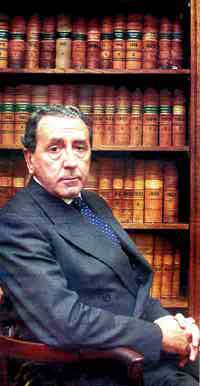
OUR interview with the judge was somewhat less inflammatory. It was conducted in his imposing rooms at the Royal Courts of
Justice. He spoke about many aspects of the trial including Irving’s skills as an advocate, but it is perhaps his comments about the advantages of doing without a jury which may cause the most ripples.
This case, he believes, “would really have been beyond the powers of any 12 men and women” because of its complicated nature.
When we first embarked on the project, several of those we consulted —
academics, lawyers, historians —
expressed discomfort about the programme.
There was a danger, they felt, that we would merely provide Irving with further publicity and an additional media platform from which to renew his protestations, after judgment had so conclusively been passed.
Irving does make comments in the programme which some may find objectionable. (“I find the Jews endlessly boring,” he told us. “They go on about the
Holocaust because it’s the only interesting thing that’s happened to them in the past 3,000 years.”) But their inclusion was necessary to convey a proper sense of his perspective of the trial.
Some of the interviews are very powerful. Lipstadt spoke at length to
Cockerell an hour or so after the Court of
Appeal’s decision, in very personal terms about what it was like to be at the centre of the trial without actually giving evidence. She also talked of the emotional price paid by those on the receiving end of legal actions and of the weight of responsibility she felt toward Holocaust survivors, her own family and her university.
What the case boiled down to was the way that historians treat and interpret the evidence before them. In our programme, a group of individuals conduct a very similar exercise, in what is effectively a trial of memories and impressions.
They were all present at the trial, but the ways in which they interpret the events of that trial vary significantly –
and these are events which took place a mere 21 months ago.
© Associated
Newspapers Ltd.
Related items on this website:
The Times:
Judge sees merit in trial without
jury
Judge to
discuss his ruling in radio show |
BBC
link
Lipstadt
action | press
index